:::::::::::::::::::::::::::::::::::::::::::::::::::::::::::::::::::::::::::::::::::::::::::::::::::::
Fudo Pilgrims in Shikoku
Temple Nr. 06 . Fudo-In . 不動院
第6番 秀盤山 不動院 真言宗大覚寺
徳島県三好郡井川町西井川 0883-78-2917
"Pierced Fudo", Kirimomi Fudo 錐揉不動, 錐揉み不動,
きりもみ不動, 錐鑽不動
揉み錐.. momigiri, basically means "drilling into wood to make a fire".
See below.
Keishini Doji 計子爾童子

© PHOTO : www.rokuriyu.or.jp
Mantra
on kaku mari sowaka
おん かく まり そわか
:::::::::::::::::::::::::::::::::::::::::::::::::::::::::::::::::::::::::::::::::::::::::::::::::::::
The Legend of Kirimomi Fudo and Kakuban
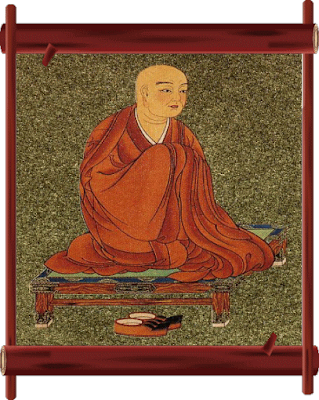
Kogyo Daishi (Koogyoo Daishi) 興教大師
There was once saint Kakuban 覚鑁[1095~1143], who practised at Koyasan at the temple Mitsugon-In 密厳院. He was not well liked by his fellow monks, because he was very strict and also tried to teach them about the Amida faith. Kakuban founded Shingi Shingon sub-sect, and wrote an essay about "Amida hishaku", an esoteric interpretation of the Pure Land teachings. He promoted an esoteric interpretation of teachings of the Pure Land. He believed that the central buddha of Shingon devotion, Vairocana Buddha, and Amida Buddha were one and the same and that their pure lands were also one and the same.
The monks of temple Kongobu-Ji wanted to kill him and entered his temple. When they came to the Fudo Hall, there were two identical statues of Fudo. One was the monk Kakuban hidden as this figure, and one was the Fudo statue itself. The monks shot two arrows in the knee of each statue, piercing the leg of each and saw red warm blood ran from both of them. The murderers became afraid and ran away.
Later Kakuban left Koyasan
and spent the rest of his life at the temple Negoro-Ji.
Another source quotes about Saint Kakuban:
Kakuban, popularly known as Mitsugon Sonja (Venerable Mystic Glorification), was born in Fujitsu-no-sho, Hizen Province (near the present Kagoshima City), on the 17th of the 6th month, 1095. His father Isa-no-Heiji Kanemoto was a high officer in charge of a manor belonging to the Ninnaji temple, and his mother came from the Tachibana family. Born as the third of four sons, he was called Yachitose-maro.
According to the Genko-shakusho, one day when Kakuban was eight years old, a messenger of the provincial governor came to see his father to press him for payment of taxes. The messenger's attitude was rude, and the boy's father was hiding behind the screen. The boy was shocked and asked the monk who was staying at his house, "Who was that messenger?" and "Who is the highest authority in Japan?" After learning that the emperor was the highest person, he further asked the monk if there was someone superior to the emperor. The monk replied that the Buddha was the supreme authority. This incident prompted him to decide to become a Buddhist; whereupon he himself burned incense as an offering to the Buddha.
His father died when Kakuban was ten, and in 1107, at the age of 13, he went to Kyoto and became a disciple of Kanjo, the founder of the Joju-in Hall and a well-known esoteric adept. In the following year, he went to Nara to study the Kusha and Hosso teachings under Keigyo at the Kofukuji. In 1110 he returned to the Joju-in and received the ordination of a novice from Kanjo and was given the name Shogaku-bo Kakuban - "Enlightened VAM" (VAM is the mystic syllable of Mahavairocana in the Vajra-realm Mandala). After the ordination, Kanjo sent him to Nara again - this time to the Todaiji to learn the Sanron and Kegon Teachings. While studying in Nara, Kakuban had a dream in which a Shinto god urged him to go up to Mt. Koya. So he once again returned to the Ninnaji and began the preparatory practice for becoming an acarya.
In 1114, at the age of 20 Kakuban received the full ordination of a monk at the Todaiji, Nara, and then went up Mt. Koya, where he was greeted by a Nembutsu sage, Shoren of the Ojo-in. Being a devout aspirant to Amida's Pure Land, Shoren undoubtedly had a great influence on Kakuban. Kakuban learned many ritual practices under Meijaku, who was also known as an aspirant to the Pure Land through the Shingon Nembutsu. Under Meijaku's guidance, Kakuban particularly practiced the ritual called "Kokuzo gumonjiho," dedicated to Kokuzo (Akashagarbha) Bodhisattva. During his stay on Mt. Koya, until he was 27 of age, he also received the Dharma-transmission abhiseka (Denbo kanjo) as many as eight times.
In 1121 Kakuban received from Kanjo of the Ninnaji the abhiseka of the two Mandalas, the Realm of Matrix-store and the Realm of Vajra. Later he tried again and again to master the Kokuzo gumonjiho ritual, until at the ninth attempt in 1123 he attained the transcendent state, and thus spiritual awakening dawned in his mind.
In 1125 Kakuban is said to have written the Koyoshu, 3 fascicles, explaining the way of birth in Amida's Land, and sent it to his mother. In the following year, he wished to build a hall on Mt. Koya to revive the lecture-meeting of transmission of the Dharma, called "Denbo-e", which was originated by Kukai for the promotion of studies in esoteric Buddhism. Coincidentally, a large estate in Wakayama was donated to him, so he invoked Shinto gods and built there a shrine to guard the Denbo-in which was to be built on Mt. Koya. Later the Negoroji was built on this site. In 1130 Kakuban received the patronage of the Ex-emperor Toba and his sanction to build the Denbo-in on Mt. Koya. Since that temple proved to be too small, in 1131 he built the Daidenbo-in temple (Great Denbo-in). Thus he succeeded in establishing a center for the study and practice of Shingon.
Kakuban's next effort was to rehabilitate the Shingon rituals. At that time, there were two traditions of rituals in the Tomitsu (the esoteric Buddhism of Shingon as opposed to that of Tendai): the Ono and Hirosawa schools, each divided into sub-schools. Besides those, on Mt. Koya another school, called "Chuin," was founded by Meizan (1021-1106). Kakuban sought to unify them all by establishing the Denbo-in school.

English biography of the restorer of Shingon Esoteric Buddhism,
the “saint of inward concentration” Kakuban
In 1134, an imperial decree was issued to designate the Daidenbo-in and the Mitsugon-in, the latter constructed as Kakuban's residence, as temples for offering up prayers for the emperor, and Kakuban was nominated as the first zasu of the Daidenbo-in. Monks of the Kongobuji, the head temple of Mt. Koya, became angry and tried to expel Kakuban, but an Ex-emperor's decree ruled that those monks be punished. Later that year, Kakuban was additionally appointed zasu of the Kongobuji. Until that time, the zasu of the Toji temple in Kyoto had also been the zasu of the Kongobuji, and so Mt. Koya had been effectively under the jurisdiction of Toji.
Worried about further incurring the wrath of those monks who had already sought his expulsion, Kakuban finally resigned as zasu of both temples and retired to the Mitsugon-in.
Nevertheless, the antipathy of the Kongobuji monks against Kakuban was aggravated. They even took to arms and attempted to kill him. Kakuban, however, remained in the Mitsugon-in and began a discipline of silence for a thousand days. In 1139, the armed monks destroyed the Denbo-in and its sub-temples, numbering more than eighty. Kakuban fled to Negoro in Wakayama, never to return to Mt. Koya again.
He spent the rest of his life there teaching students and writing books. In 1143 when he was 49 years of age, he became ill, and later that year he passed away while sitting in the lotus posture, making the appropriate mudra, and facing towards Mahavairocana's Pure Land. He was given the posthumous title Kogyo Daishi (the Master who Revived the Teaching) by Emperor Higashiyama in 1690.
Reconciliation and conflict ensued between the Kongobuji and the Negoroji, lasting for more than a hundred years. The great master Raiyu (1226-1304) finally moved the Daidenbo-in and the Mitsugon-in to Negoro in 1288, and declared the independence of the new school, called Shingi Shingon.
source : Hisao Inagaki
Kirimomi Fudo from temple Negoro-Ji
Wakayama
錐もみ不動明王, 根来寺不動堂 岩出市
三国一のきりもみ不動 :
Fudo unparalleled in the three countries Japan, China and India
厄除け身代わり不動尊 yakuyoke migawari Fudo son
This is a sacred statue, who once protected Kakuban from his enemies.
It is only shown to the public for one week in November, starting from Nov. 17.
Negoro Temple is Nr. 34 on the Fudo Pilgrimage in the Kinki area.

source : kanko.wiwi.co.jp/world/english/
Japanese Reference
Kakuban, English Reference
. Yakuyoke Fudo 厄除不動 Fudo to ward off evil .
. Kirimomi 錐揉不動, 錐揉み不動, きりもみ不動, 錐鑽不動
Pierced Fudo Myo-O .
. Pilgrimages to 36 Fudo Temples in Kinki
近畿三十六不動尊巡礼 .
- quote -
The Negoro-Ji (根来寺) complex of Buddhist temples
stands on the side of, and is surrounded by, the sacred peaks of the Katsuragi Mountains which dominate the horizon at the northern end of the city of Iwade, Wakayama in Japan.

In 1087, a man named En no Gyōja established this area as a center for promoting Buddhism. Hōfuku-ji, as it was originally called, was built with the contributions of a devotee known as Hōfuku-Chōja who lived in the vicinity.
In 1132, the Ex-Emperor Toba donated this temple, along with nearby manors, to the famous high priest Kōgyō Daishi; this new estate was called Ichijō-zan Daidenpon Negoro-ji. Kōgyō-Daishi, widely renowned as the restorer of the Shingon sect of Buddhism, moved here with his pupils, from Mount Kōya.
After settling at Negoro-ji, Kōgyō-Daishi laid out his far-sighted plans and initiated the construction of the Enmyō-ji and Jingū-ji within the Negoro-ji temple grounds. Even after his death, in 1143, the Negoro-ji complex was influential and prosperous as the head seminary for Shingi sect of Shingon Buddhism for another 200 years or so. During the height of its influence in the late Muromachi period, about 2700 temples stood on the mountainside in the spacious grounds of Negoro-ji.
In 1585 however, every building except the main pagoda, and a few others, were burnt down during the Siege of Negoro-ji by Toyotomi Hideyoshi, who feared the growing military power of the priesthood and the Negoro-gumi, warrior monks of the temple, who were skilled in the use of firearms.
In 1623, the head of the Kii branch of the Tokugawa feudal clan, Tokugawa Yorinobu, initiated the reconstruction of the temple grounds, and through numerous re-buildings over many decades during the Edo period, the Negoro-ji was completely transformed.
- - - More in the WIKIPEDIA !
:::::::::::::::::::::::::::::::::::::::::::::::::::::::::::::::::::::::::::::::::::::::::::::::::::
. Saga Saga 佐賀県 Henro Pilgrims and Kirimomi .
Nr. 62 密厳山 誕生院 Mitsugonzan Tanjo-In
Nr. 63 金剛勝山 蓮厳院 Kongoshozan Renge-In
四国三十六不動尊霊場会
Fudo Pilgrims in Shikoku
[ . BACK to DARUMA MUSEUM TOP . ]
[ . BACK to WORLDKIGO . TOP . ]
:::::::::::::::::::::::::::::::::::::::::::::::::::::::::::::::::::::::::::::::::::::::::::::::::::::::


 Posts
Posts




4 comments:
Kirimomi Fudoo
錐揉不動, 錐揉み不動, きりもみ不動, 錐鑽不動
Kirimomi Pierced Fudo Myo-O Statues
Edo - 薬研堀不動院 Yagenbori Fudo-In
This temple was founded in 1585 by 大印僧都 Daiin Sozu.
The main statue is Tsuzura Fudo Myo-O 葛籠不動明王 "Fudo in a wicker box".
This is one of the Three Great Fudo Statues of Edo 江戸三大不動.
The Fudo statue had been carved by the venerable priest
. 興教大師覚鑁 Kogyo Daishi Kakuban (1095 - 1143) .
at the temple 根来寺 Negoro-Ji in Wakayama.
Priest Daiin had packed this statue in a wicker box and carried it all the way to Kanto after Toyotomi Hideyoshi had burned the temple Negoro-Ji in 1585. He found this place suitable and built a temple for the statue.
.
https://gokurakuparadies.blogspot.jp/2017/01/gofunai-temples-22-and-23.html
.
摩尼山 Manizan 吉祥院 Kissho-In 隆全寺 Ryuzen-Ji
台東区元浅草2-1-14 / Taitō ward, Motoasakusa, 2 Chome−1−14 - Tokyo
.
The main statue is 阿弥陀如来 Amida Nyorai.
It is flanked by statues of 弘法大師 Kobo Daishi and
輿教大師 Kogyo Daishi Kakuban
.
https://gokurakuparadies.blogspot.jp/2017/03/gofunai-temples-60-and-61.html
.
Tajima Migawari Chi Fudo 田島の身代わり血不動尊 Substiture Fudo painted with blood
伝灯山 Dentozan 和光院 Wako-In 明楽寺 Myoraku-Ji
.
Fudo painted on silk by 興教大師 Kogyo Daishi with his own blood
.
https://gokurakuparadies.blogspot.com/2020/04/tajima-chi-fudo.html
.
Post a Comment