:::::::::::::::::::::::::::::::::::::::::::::::::::::::::::::::::::::::::::::::::::::::::::::::::::::
Narita Fudo 成田不動尊
Shinshooji 新勝寺 Temple Shinsho-Ji
成田山 平和大塔 Peace Pagoda

大本山成田山新勝寺 大塔掛仏係
〒286-0023千葉県成田市成田1番地
http://www.naritasan.or.jp/benefit/daitonobutu.html
The Peace Pagoda in Narita was built in 1984. It is 58 m high and situated on a small hill.
In the second floor, a 6 meter large statue of Fudo Myo-O is placed.

In the fifth floor, the Diamond Hall (kongooden 金剛殿 こんごうでん)five statues of the five Wisdom Nyorai (gochi Nyorai 五智如来 ごちにょらい) are placed.
Mark Schumacher about the
Five Buddhas of Wisdom
:::::::::::::::::::::::::::::::::::::::::::::::::::::::::::::::::::::::::::::::::::::::::::::::::::::::
- quote -
Narita San 成田山 Shinshō-ji 新勝寺 "New victory temple"
The temple was established in 940 to commemorate the victory of the forces dispatched from the Heian capital to suppress a revolt by the powerful Kantō region samurai, Taira no Masakado.
The Shingon priest 寛朝大僧 Kanchō accompanied the force, bringing with him an image of Fudō myōō from the Gomadō (Fire Offering Hall) of Takao-san Jingo-ji in Kyōtō. Shingon founder 弘法大師 Kōbō Kobo Daishi himself was said to have carved the image and used it in Goma sacred fire rituals that helped stop a rebellion during his era. The rebellion in 940 also came to an end just as Kanchō completed a three-week Goma ritual with the same image.

source : naritasan.or.jp
According to legend, the image of the Unmovable Wisdom King became too heavy after the victory to move back to its home base, so a new temple on Narita-san, named Shinshō-ji (New Victory Temple), was built to enshrine it on the spot.
The temple maintains that the original image is enshrined in the Main Hall, where it is displayed on special occasions, but art historians date the current image to no earlier than the 13th century.
- source : wikipedia -
. Kōbō Daishi Kūkai 弘法大師 空海 Kobo Daishi Kukai .
. (774 - 835)
. Taira no Masakado 平将門 / 平將門 .
(? - 940)
:::::::::::::::::::::::::::::::::::::::::::::::::::::::::::::::::::::::::::::::::::::::::::::::::::::::
A stone statue of Fudo Myo-O from the temple Daigo-Ji in Kyoto, said to be carved by Kukai himself, was brought to the Kanto area to bring peace to the region and marks the beginning of Narita Fudo in Chiba.
. Daigoji 醍醐寺 Daigo-Ji .
:::::::::::::::::::::::::::::::::::::::::::::::::::::::::::::::::::::::::::::::::::::::::::::::::::::::
nana seigan 七誓願 Seven Sincere Vows
in the presence of Fudo Myo-O

・明るい笑顔で奉仕のはげみ-奴僕(ぬぼく)の行 -nuboku
・まごころこめて助け合い-羂索(けんさく)のおさとし - kensaku
・苦難に耐えれば開ける希望-盤石(ばんじゃく)の決意 - banjaku
・精進努力に豊かな実り-燃えさかる火炎 - kaen
・常に冷静 不動の心-ゆるぎなきみ心
・正しい判断さとりのめざめ-利剣(りけん)の智慧 - riken
・いただくご利益(りやく)みんなと共に-加持力(かじりき)- kajiriki
- reference -
:::::::::::::::::::::::::::::::::::::::::::::::::::::::::::::::::::::::::::::::::::::::::::::::::::::::
Kabuki and Narita San
A succession of actors named Danjuro Ichikawa whose house name is 'Naritaya' has a deep relationship with Naritasan for many generations. The first Danjuro Ichikawa was born in 1660 during the Edo period. His father, Juzo Horikoshi was from Hataya in Narita city. Even now at the graveyard in the Toko-ji temple in Hataya, there is Danjuroo the first's tomb which was built by Danjuro the second.
Danjuro the first had difficulty having a child so he prayed to the Narita Fudo-myoo god and soon after had Danjuro the second. After that his Kabuki themes revolved around the spirituality of the Narita Fudo-myoo god. His play, 'Tsuwamonno-kongen-soga' became a hit. His successors, also named, Danjuro were also deeply religious in the Fudo-myoo god and performed a play called 'Risho-ki' about how people can be blessed by the Fudo-myoo god. Thanks to the success of their plays, the Fudo-myoo god became well-known among the people of the Edo period. Danjuro the seventh was also a believer and he donated one thousand Ryo (monetary unit of the Edo period) to build Gaku-do hall.

Danjuro II
Edo (Tokyo) peoples interest in Naritasan was stimulated by Kabuki performances and Naritasan monks displayed the Fudo-myoo god at Fukagawa-eidaiji temple. Eventually worship at Naritasan became popular with Edo (Tokyo) people through. At first, worship at Naritasan was only popular with high society and wealthy merchants, however, between 1804 and 1829 it became more popular with ordinary people because it was enjoyable four day return hike through beautiful scenery.
source : www.city.narita.chiba.jp

The makeup of Danjuro II, called kumadori 隈取, was taken from the facial expression of the statue of Fudo Myo-O itself.
When Danjuro performed in Edo, people identified him with the deity and would throw donation money at the stage.

Ichikawa Danjūrō XII
(April 1985 - February 2013)
Previously known as Ichikawa Shinnosuke VI and Ichikawa Ebizō X.

Danjūrō was diagnosed with leukemia in late spring 2004, after falling ill and becoming unable to perform alongside his son (Ichikawa Ebizō XI), who was celebrating his shūmei at the time, having become the latest to take the name Ichikawa Ebizō. Though illness, and subsequent hospitalization, forced Danjūrō to leave the stage for long stretches in 2004-05, he later returned.
He died of pneumonia in a Tokyo hospital on February 3, 2013 at the age of 66.
© More in the WIKIPEDIA !
. Danjuro XII
and the freedom in Kabuki acting .
Danjuro painted a poster for the festival of the day of the fish, toto no hi 魚の日(ととのひ)
. Tsukiji Fish Market 築地市場 .

. Narukami Fudo Kitayama Zakura 雷神不動北山桜 .
Kabuki with Ichikawa Danjuro
.......................................................................
Shibaraku (暫, しばらく) "Stop a Moment!"
is among the most popular pieces in the Kabuki repertoire, and one of the celebrated Kabuki Jūhachiban (Eighteen Great Plays)

The plot centers around the figure of Kamakura Gongorō Kagemasa, who has become the stereotypical bombastic hero of the kabuki stage, with red-and-white striped makeup and strong, energetic movement. The historical Kamakura Kagemasa is famous for his bravery for having continued to fight after losing an eye in battle in the Gosannen War (1083-1087).
- - - More in the WIKIPEDIA !
. Kamakura Gongorō Kagemasa 鎌倉権五郎景政
(born 1069) .
:::::::::::::::::::::::::::::::::::::::::::::::::::::::::::::::::::::::::::::::::::::::::::::::::::::::
source : Naritasan Shinshoji Temple HP
O-Mamori - Amulets

for luck with money

to find a good partner - 恋愛成就絵馬

small scroll with Fudo Myo-O - kakejiku 尊影掛軸

Goma Amulet
Gomafuda is wooden amulet to receive benefits, which has been placed over a fire and blessed with the spirit of Fudomyoo through a Goma fire rite.
Migawari-omamori (Substitute-amulet) is a small amulet to ward off accidents and evils.
The Goma fire rite is the most important of the services conducted in Naritasan Shinshoji Temple, a temple of Shingon Esoteric Buddhism. It is conducted several times every day and anybody can attend. The Goma rite is a mysterious temple service in which we pray to Fudomyoo, the main deity of Naritasan Temple, for the fulfillment of our wishes.
The chief priest burns Goma sticks with various burnt offerings. The fire, a symbol of the wisdom of Fudomyoo, extinguishes our earthly passions, which are symbolized by the sticks, and brings us to a higher state of mind to win the virtues and favors of Fudomyoo.
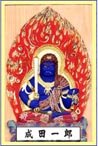
Fudomyoo, one of the popular Buddhist deities, is fierce-looking and wreathed in flames with a sword and a rope in his hands. The sword cuts away hindrances of passion and false knowledge, and the rope is used to draw in beings to Enlightenment. To demons he is terror, but to the faithful he is the remover of anxieties, banisher of evil and savior from oppression.
Fudomyoo of Naritasan Temple has been worshiped by numerous people from all over the country for a long time.
source : Narita san - Omamori
. Amulets and Talismans from Japan .
:::::::::::::::::::::::::::::::::::::::::::::::::::::::::::::::::::::::::::::::::::::::::::::::::::::::

Print by Utagawa Kunisada / Toyokuni III
Ichikawa Ebizō V
as the Mystical Image (Reizō) of Fudō Myōō,
Ichikawa Saruzō I as Kongara dōji (矜迦羅童子), and
Ichikawa Komazō VII as Seitaka dōji (制吒迦童子)
No. 9 (九) from the series Eighteen Great Kabuki Plays
(Jūhachiban no uchi -十八番の内)
source : Lyon Collection
:::::::::::::::::::::::::::::::::::::::::::::::::::::::::::::::::::::::::::::::::::::::::::::::::::::::
Ichikawa Ebizo, Ebizoo
十一代目 市川 海老蔵
The 11th Ishikawa, born 1977年12月6日
In December 2010, he caused quite an uproar when involved in a drunken pub brawl, causing him multiple fractures of facial bones.
. . . getting into a drunk brawl
:::::::::::::::::::::::::::::::::::::::::::::::::::::::::::::::::::::::::::::::::::::::::::::::::::::
Bronze Fudo in a Wood Shrine

. Fudo Myoo : Bronze Buddha In Wood Shrine
:::::::::::::::::::::::::::::::::::::::::::::::::::::::::::::::::::::::::::::::::::::::::::::::::::::
A Peace Pagoda Heiwa Daitoo
is a Buddhist stupa designed to provide a focus for people of all races and creeds to help unite them in their search for world peace. Most (though not all) have been built under the guidance of Nichidatsu Fujii (1885-1985), a Buddhist monk from Japan and founder of the Nipponzan-Myōhōji Buddhist Order. Fuji was greatly inspired by his meeting with Mahatma Gandhi in 1931 and decided to devote his life to promoting non-violence. In 1947, he began constructing Peace Pagodas as shrines to World peace.
The first Peace Pagodas were built as a symbol of peace in the Japanese cities of Hiroshima and Nagasaki where the atomic bombs took the lives of over 150,000 people, almost all of whom were civilian, at the end of World War II.
By 2000, 80 Peace Pagodas had been built around the world in Europe, Asia, and the United States.
"Civilization is not to kill human beings, not to destroy things, not to make war; civilization is to hold mutual affection and to respect one another."
-Most Ven. Fujii
Peace Pagodas in Asia
2.1 Hanaokayama, Japan
2.2 Hiroshima, Japan
2.3 Nagasaki, Japan
2.4 , India
2.5 Mount Kijosumi, Japan
2.6 Narita-shi, Chiba-ken, Japan
2.7 Darjeeling, India
2.8 Vaishali, India
2.9 Ladakh, India
2.10 Lumbini, Nepal
2.11 Gotemba, Shizuoka, Japan
2.12 Pokhara, Nepal
© Quote from the Wikipedia
:::::::::::::::::::::::::::::::::::::::::::::::::::::::::::::::::::::::::::::::::::::::::::::::::::::

Photo by my friend Hiroya Sato
and look at this video by Hiroya san:
Moonlight illuminates the Shinsho-ji Temple
Join us:
. Joys of Japan - Facebook Friends .
:::::::::::::::::::::::::::::::::::::::::::::::::::::::::::::::::::::::::::::::::::::::::::::::::::::
Haiku and Peace
World Peace Day International Day of Peace
War and Peace (sensoo to heiwa)
:::::::::::::::::::::::::::::::::::::::::::::::::::::::::::::::::::::::::::::::::::::::::::::::::::::
Last Fire Ritual at Narita Fudo :
"Osame-Fudo" is a kigo for Winter.
.......................................................................
Many temples have a Fudo statue consecrated at Narita (bunshin 分身), and are also called
xyz - Narita Fudo 成田不動.
They will be added in the comments to this entry as we continue the pilgrimages.
:::::::::::::::::::::::::::::::::::::::::::::::::::::::::::::::::::::::::::::::::::::::::::::::::::::
Pilgrimages to 36 Fudo Temples in Kanto 関東三十六不動霊場
Nr. 36, the last one
. . Pilgrimages to Fudo Temples 不動明王巡礼
Fudo Myo-O Junrei - Introduction . .
::::::::::::::::::::::::::::::::::::::::::::::::::::::::::::::::::::::::::::::::::::::::::::::::::::::::::
. Japanese Legends - 伝説 民話 昔話 – ABC-List .
daisoojoo 大僧正 Daisojo, the Great Priest
The legend of 寛朝大僧 Great Priest Kanchō, see above
Yuuten 祐天 Saint Yuten
The young Yuten went to Narita san to pray to Fudo for wisdom.
- - - Read what Fudo did to the young acolyte:
. Yuuten, Yūten 祐天 Yuten Shami (1637 - 1718) .
.......................................................................
- reference : Nichibun Yokai Database -
::::::::::::::::::::::::::::::::::::::::::::::::::::::::::::::::::::::::::::::::::::::::::::::::::::::::::
[ . BACK to WORLDKIGO . TOP . ]
[ . BACK to DARUMA MUSEUM TOP . ]
- #naritafudo #fudonarita #naritashinshoji #shinshojinarita -
::::::::::::::::::::::::::::::::::::::::::::::::::::::::::::::::::::::::::::::::::::::::::::::::::::::::::


 Posts
Posts




9 comments:
Minakamidera 水上寺 Minakami-dera
Nr. 1 成田山 - 水上寺 - 成田山水上不動尊
Narita san Minakamidera Fudo Son
This temple has as main statue one from the great Narita Fudo temple in 1888.
People carried the statue on their shoulders for 28 days from Narita to here.
MORE
.
Nr. 2 海王山 - 善福寺 金剛院 - 沼田成田不動尊
Kaio-zan Zenpuku-Ji, Numata Narita Fudo Son
. 北関東三十六不動尊霊場
36 Fudo Temples in Northern Kanto .
.
Hoozooji 宝蔵寺 Hozo-Ji
19 光明山 摂取院 宝蔵寺 - 成田不動
Komyosan, Sesshu-In, Hozoji - Narita Fudo
Tochigi prefecture 口密の道場 - kumitsu
. 北関東三十六不動尊霊場
36 Fudo Temples in Northern Kanto .
Teppo Fudoozuke 鉄砲不動漬 Teppo Fudo Pickles
This melon pickle, a specialty of the area around Narita airport near Tokyo, takes its name from the long, thin shape, like the barrel of a rifle (teppo) .
Dooyo Shoonin 道誉上人 Doyo Shonin
(1515 - 1574)
at Narita san
- Persons related to temple Narita san, Chiba -
源頼朝 (1147 - 1198) Minamoto no Yoritomo
海保甲斐守三吉 Kaiho daimyo from Kai (no dates)
徳川光圀 (1628 - 1700) Mito Mitsukuni
山内容堂 (1827 - 1872) Yamauchi Toyoshige
山岡鉄舟 (1836 - 1888) Yamaoka Tesshu
倉田百三 (1891 - 1943) Kurata Hyakuzo
Ninomiya Sontoku 二宮尊徳 Kinjirō 金次郎 Ninomiya Kinjiro
(1787 – 1856)
.
Personal encounters with Fudo Myo-O
.
Setsubun Chant
「福は内」 - only Fuku wa Uchi! Good Luck come in!
- 成田山新勝寺(千葉県成田市)
.
https://kappapedia.blogspot.jp/2017/04/oni-wa-uchi-oni-mo-uchi.html
.
Chiba Kaido 千葉街道 Chiba Highway
成田街道 Narita Kaido / Narita michi 成田道 Road to Narita
Connecting Edo / Shinjuku to the famous temple in Narita.
.
https://edoflourishing.blogspot.com/2019/12/chiba-narita-kaido-highway.html
.
Manpukuin 萬福院 Manpuku-In - Sakae, Nagoya
成田山 Naritazan 萬福院 / 万福院 Manpukuin
愛知県名古屋市中区栄5-26-24 / Aichi, Nagoya city, Naka ward, Sakae
.
https://gokurakuparadies.blogspot.com/2021/04/manpukuin-fudo-sakae-nagoya.html
.
Post a Comment