:::::::::::::::::::::::::::::::::::::::::::::::::::::::::::::::::::::::::::::::::::::::::::::::::::::
Kobo Daishi Kukai 弘法大師 空海
(Kooboo Daishi, Kuukai) Kōbō Daishi Kūkai .. .. .. (774 - 835)
Founder of Shingon Japanese Esoteric Buddhism
For kigo about Kuukai see below.

Edited from an article by Koyu Sonoda:
There are few figures in Japanese history about whom such abundant biographies have been written as Kukai, popularly known by his posthumous title, Kobo Daishi.
Kukai was born in 774 in Sanuki Province on Shikoku. His birth name was Saeki no Mao. At seventeen he succeeded in entering the university. The trained his memory by using the Mantra of Akashagarbha.
In the autumn of 804, the first of the official diplomatic ships, in which Kukai was traveling, arrived in northeastern Fukien province in China. In the autumn of 806, Kukai returned to Japan.
Kukai's dazzling genius is graphically apparent in the calligraphy of a letter to Saicho (最澄), which is considered his greatest masterpiece.
He founded a temple on Mount Koya (高野山) in 816. Early in 823, Kukai was granted Toji (Too-ji 東寺), a temple situated at the entrance to Kyoto.
Kukai died on Mount Koya on April 23, 835, and it is believed that even now he remains in eternal samadhi in his bodily form within the inner shrine on the mountain.
Most ubiquitous are the tales about wells and springs associated with Kukai. A typical story is that in a certain village there was not sufficient water for irrigation, so the villagers had to be sparing in use of the water they drew from a far-off well. One day, there came passing through the village a traveling priest, who asked for a drink. The villagers willingly brought him one, whereupon the traveler, in thanks, struck the ground with his staff and a spring of water came gushing up. The traveler was in fact Kukai.
The best known of such activities is his direction of the reconstruction of the reservoir called Mannoike in Sanuki Province on Shikoku.
Read the complete story of his life here, please:
http://www.asunam.com/kukai_page.htm
Safekeep Copy is here:
http://groups.yahoo.com/group/DarumaArchives-002/message/61
Kukai is often depicted on scolls or paintings seated, with a water container, a sprouted jar or water dropper or ritual ewer (kundika, Buddhist ritual sprinkler) beside him.
Quote
The vessel is probably best referred to as a ewer or kundika.
It references initiations (abhiseka [abhis'eka] ) in the historical transmission of Mikkyô. The Indian kundika (kun[.bel]d[.bel]ikâ ) was originally used for the royal accession ceremony for water from the four or five oceans poured on the head of the recipient; in Tantric traditions five ewers are often used. (Ennin received abhisekha from the master Yuanzheng 元政 with the Diamond World mandala then received the initiation of the Five Pitchers).
Read more about this discussion here:
© Cynthea Bogel / PMJS Group 2008
Read more about Kundika and Kendi:
The kendi is a well-known form in the Southeast Asian repertoire of vessels, and it has played a significant role in the rituals and daily life of the region since ancient times.

'Kendi' is a Malay word derived from the Sanskrit name 'kunda,' which came from 'kundika' a particular form of Indian vessel used as a container for liquids in both Hindu and Buddhist ceremonies.
Kendi in the Cultural Context of Southeast Asia
Dawn F. Rooney
Library
Buddhist Artwork and Kobo Daishi
with more detailed information about Kukai by
source : Mark Schumacher
.......................................................................
. Shikoku Henro Temple List 四国お遍路さん Henro Pilgrims .
. Legends about Kobo Daishi - 弘法大師 空海 - 伝説 .
:::::::::::::::::::::::::::::::::::::::::::::::::::::::::::::::::::::::::::::::::::::::::::::::::::::
Kobo Daishi for a modern need:
To bring children and good luck (like Daruma san).
子授招福大師 Kosazuke Daishi
An Offering from a Daishi Group in Osaka.
At the Temple Gokuraku-Ji, Nr. 2 in Shikoku.
修行大師像 平成十五年(2003年造像) 大阪極楽講同行による勧請、子授け招福をかなえて下さる修行大師様、 他の修行大師と違い子供を抱いておられるのが特徴 .
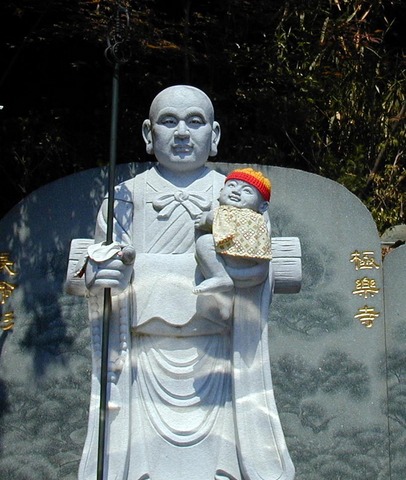
See my pictures Nr. 04 - 09 for more details.
... Photo Album Gabi Greve
Temples where to pray for conceiving of children. Usually Kannon or Jizo tend to that business. See
Child Protectors By Mark Schumacher
Here are many Japanese Temples for that purpose.
子授け寺・神社情報 へ
. Daishi Darani joo 大師陀羅尼錠
Kobo Daishi Darani Medicine for stomach ailments .
Daisho-In 大聖院 , Miyajima
:::::::::::::::::::::::::::::::::::::::::::::::::::::::::::::::::::::::::::::::::::::::::::::::::::::
Kenmai hooyoo 弘法大師献米法要
Rice offerings for Kobo Daishi
Ritual at the temple Toji in Kyoto 京都・東寺

On the second sunday in April.
Kenmai-Hoyo (Buddhist memorial service presenting rice)
:::::::::::::::::::::::::::::::::::::::::::::::::::::::::::::::::::::::::::::::::::
I have written a few articles about Kukai.
Ajimi Jizo 嘗試地蔵
Jizo Bosatsu tasting the food for Kobo Daishi
Koya San in Wakayama 高野山 和歌山県
Namikiri Fudo Wave-cutting Fudo 波切不動尊 、浪切不動明王
Carved by Kobo Daishi himself.

http://www.daihorin-kaku.com/bijutsu/namikiri-fudo.htm
Sunafumi Ceremony お砂踏み (Shikoku Pilgrimmage) O-Sunafumi, osunafumi
Pilgrimages in the name of Kobo Daishi
Daruma San in Japan, Japanese Art and Culture: Washi, Japanese Paper
:::::::::::::::::::::::::::::::::::::::::::::::::::::::::::::::::::::::::::::::::::::::::::::::::::::
Kukai Kobo Daishi and KIGO for Haiku
Kuukai Kooboo Daishi is a well known personality in the living Buddhism of Japan.
Many of the ceremonies and festivals in his honour are kigo. Here we will list a few.
.. .. Late Spring
March 21 :
Kuukai Kooboo Daishi Memorial Day
This kigo has various other names listed here:
Kuukai Memorial Day and Ceremony, miei-ku 御影供、mie-ku みえく (in Osaka)
..... (Miei literally means: The Honorable Shadow. This type of memorial service for a deceased person is also performed for normal people. In the case of Kobo Daishi, a memorial service is performed each month on the 21st.)
Orthodox Memorial Service, shoo miei-ku 正見御影供 (April 21 at Tooji, Kyoto)
Memorial Group, Miei-koo 御影講, Daishikoo 大師講
..... ( A Daishiko is a group of followers of Kobo Daishi and Shingon Buddhism under the guidance of a temple. Koyasan Shingon Tenchi-ji: Daishiko )
Kooboo Memorial Day, Koobooki (Kobo-ki) 弘法忌
Kuukai Memorial Day, Kuukaiki (Kukai-ki) 空海忌
Dear Kooboo, Koobo san 弘法さん
..... (Called like this by the people of Kyoto.)
changing of his robes, mi-koromogae 御衣替, o-koromo-i 御衣井
..... (His mummy kept at Koya-San gets the robes changed to summer a lighter dressing. They are changed back to warmer winter wear in November. The mummy also gets food and water every day. The water is drawn from a holy well at the Temple Hooki-In 宝亀院, and sold as medicine for all sorts of ailments there as "Holy Water" reisui 霊水. Hooki is the name of the period when Kobo Daishi was born. http://www.koya-san.jp/xc/gbase/disp/70/me )
Visiting three Kooboo temples, san Kooboo mairi 三弘法参り,
.. also : san Kooboo moode 三弘法詣で (in Kyoto, at temple Tooji on the first to third of January)
Visiting Ninna-Ji, O-Muromairi 御室参り (仁和寺)
..... (Famous for its beautiful cherry blossoms .)
Ladies visiting Jingo-Ji, Takao-san onnna moode 高雄山女詣, 高尾山女詣 (神護寺)
.....(On this day, ladies were allowed to the holy places otherwise only accessible to men.)

source : Otsuka Tsutomu - facebook
. Ninnaji 仁和寺 Ninna-Ji, Kyoto .
. Fudō Myō-ō, Fudoo Myoo-Oo 不動明王 Fudo Myo-O
Acala Vidyârâja - Vidyaraja .
:::::::::::::::::::::::::::::::::::::::::::::::::::::::::::::::::::::::::::::::::::::::::::::::::::::
.. .. Mid-Summer
aoba matsuri 青葉祭 (あおばまつり) festival of green leaves
Kooboo Daishi kootann e 弘法大師降誕会(こうぼうだいしこうたんえ)
birthday ritual for Kobo Daishi

quote
June 15 is the birthday of Kobodaishi, the founder of Koyasan and Shingon Buddhism. The weather was not totally expected to be fine or even oppositely. But it was blessed by Kobodaishi's virtue and even rain waited to its fall. Not only whole town but worshippers all over Japan get together at Koyasan and celebrate Kobodaishi's birthday in many ways.
... People from Kagawa, one of the 4 prefectures in Shikoku Island where Kobodaishi was born and later opened his pilgrimage route, have participate in the parade in their pilgrimage costume. How well organized their beautiful dancing are!
... Young priests also participate in the parade and spread pieces of paper called "sangue" whose shape is a lotus petal*.
Sangue is widely given in the Buddhist services or ceremonies to hold some memorial services for Buddha or the Saint like Kobodaishi. People who get these are grateful to Buddha for his virtue.
source : www.koyasan-ccn.com
:::::::::::::::::::::::::::::::::::::::::::::::::::::::::::::::::::::::::::::::::::::::::::::::::::::
.. .. Mid-Winter
Last Meeting of the Memorial Group, Daishi-koo 大師講,
December 21
Osame no Daishi 納めの大師, 終大師 Shimai Daishi, Osame-Daishi 収め大師
. Kooya Doofu 高野豆腐 Dried Tofu from Mt. Koya .
(food)
Annual Events at Koyasan
For every month:
source : www.koyasan-ccn.com/event
:::::::::::::::::::::::::::::::::::::::::::::::::::::::::::::::::::::::::::::::::::::::::::::::::::::
.. .. New Year
First Ceremonies of the Year including
First Ceremony for Kobo Daishi, hatsu Daishi, 初大師 January 21
:::::::::::::::::::::::::::::::::::::::::::::::::::::::::::::::::::::::::::::::::::::::::::::::::::::

南無大師 石手の寺よ 稲の花
Namu Daishi Ishite no tera ya ine no hana
Masaoka Shiki
Devotion to the Great Saint,
the temple of Ishite ...
rice plants abloom.
Tr. Kametaro
Ishite-Ji Temple, Nio Gate 石手寺(仁王門)and Haiku
. Emon Saburō 衛門三郎 Emon Saburo .
Legend about the "Stone Hand Temple"
:::::::::::::::::::::::::::::::::::::::::::::::::::::::::::::::::::::::::::::::::::::::::::::::::::::
寺の子の七五三とて南無大師
tera no ko no shichi go san tote Namu Daishi
even at the Shichi-Go-San Festival
for the Temple Children -
Praise to the Great Teacher!
At Temple Shobo-Ji
Tr. Gabi Greve
................................ 南無大師遍照金剛
Namu Daishi Henjo Kongo

Namu Daishi Henjoo Kongoo
Prayer in the name of Kukai
the Gohōgō Mantra
Namu means"Oh!", Daishi is Kôbô Daishi (Kukai) and Henjô Gongô is Dainichi Nyorai.
In Mikkyô, Dainichi Nyorai is the foundation of the universe and Kukai through the ritual of Gakuho Konjo connected Dainichi Nyorai and Buddha.
In other words, the Namu Daishi Henjo Gongo are the words admiring Kôbô Daishi and Dainichi Nyorai.
© Hiroshi Kushima
:::::::::::::::::::::::::::::::::::::::::::::::::::::::::::::::::::::::::::::::::::::::::::::::::::::
.. .. .. Further Reference of the WKD
Saijiki for Buddhist Events
Memorial Days of famous people .
Pilgrimage(henro, junrei)Pilgrims
The 88 Temples Pilgrimmage of Shikoku
First Ceremonies of the year
Hanya Shingyo : Heart Sutra ..... 般若心経 ... and Haiku
Seven Five Seven (shichigosan) Japan.
Celebrating seven, five and three year old children
. . . . .
Beronaga べろ長 "the long tongue"
Taming a monster in Aizu Wakamatsu
:::::::::::::::::::::::::::::::::::::::::::::::::::::::::::::::::::::::::::::::::::::::::::::::::::::
Kobo Daishi gankake omamori 願掛けお守り
. Gankake 願掛け wish-prayer, to make a wish .
MORE
. Kukai O-Mamori 空海 お守り Amulets with Kobo Daishi .
[ . BACK to WORLDKIGO . TOP . ]
[ . BACK to DARUMA MUSEUM TOP . ]
:::::::::::::::::::::::::::::::::::::::::::::::::::::::::::::::::::::::::::::::::::::::::::::::::::::
Ikonographie von Kukai
Die acht Patriarchen der Shingon-Sekte (Shingon hasso 真言八祖(しんごんはっそ)) sind:
Ryuumyoo 龍猛, Fukuu 不空三蔵, Ryuuchi 龍智, Kongoochi 金剛智), Zenmui 善無畏 , Ichigyoo 一行禅師, Keika Ajari 恵果阿闍梨 und Kuukai (Kooboo Daishi 弘法大師・空海).
Beispiel: Reliefstatuen im Tempel Kongoochooji 金剛頂寺, Shikoku.
Besonders häufig sind Statuen von Kooboo Daishi (774 - 835), dem Gründer der japanischen Shingon-Sekte.
Auf einem großen Stuhl, in der rechten Hand einen Donnerkeil mit fünf Zacken, in der linken Hand einen Rosenkranz. Vor dem Stuhl stehen die Schuhe und ein Wassergefäß (kundika). Diese Wassergefässe werden in buddhistischen Ritualen verwendet, sie enthalten das "Wasser des Lebens". Ihr Ursprung ist in Indien (kendi, kundika), dem Ursprungsland des Buddhismus.
 Als stehende Figur im Pilgergewand, mit einem großen Strohhut, in der rechten einen Rosenkranz oder die Almosenschale und in der linken den Pilgerstab repräsentiert er so den Daishi auf seinen Pilgerfahrten (Shugyoo Daishi 修行大師).
So findet er sich häufig im Vorgarten eines Shingon-Tempels.
(c) Gabi Greve
Buddhastatuen (Buddha statues) Who is Who
Ein Wegweiser zur Ikonografie von japanischen Buddhastatuen
:::::::::::::::::::::::::::::::::::::::::::::::::::::::::::::::::::::::::::::::::::::::::::::::::::::
. Shikoku Henro Temple List 四国お遍路さん Henro Pilgrims .
. Legends about Kobo Daishi - 弘法大師 空海 - 伝説 .
:::::::::::::::::::::::::::::::::::::::::::::::::::::::::::::::::::::::::::::::::::::::::::::::::::::
[ . BACK to WORLDKIGO TOP . ]
[ . BACK to DARUMA MUSEUM TOP . ]
- #kukaidobodaishi #kukai #kobodaishi -
:::::::::::::::::::::::::::::::::::::::::::::::::::::::::::::::::::::::::::::::::::::::::::::::::::::


 Posts
Posts




38 comments:
Icons and Iconoclasm in Japanese Buddhism
Kukai and Dogen on the Art of Enlightenment
Pamela D. Winfield
Does imagery help or hinder the enlightenment experience? Does awakening involve the imagination or not? Can art ever fully represent the realization of buddahood? In this study, Pamela D. Winfield offers a fascinating comparison of two pre-modern Japanese Buddhist masters and their views on the role of imagery in the enlightenment experience.
Kukai (774-835) believed that real and imagined forms were indispensable to his new esoteric Mikky? method for "becoming a Buddha in this very body" (sokushin jobutsu), yet he also deconstructed the significance of such imagery in his poetic and doctrinal works.
Conversely, Dogen (1200-1253) believed that "just sitting" in Zen meditation without any visual props or mental elaborations could lead one to realize that ''this very mind is Buddha'' (sokushin zebutsu), but he also privileged select Zen icons as worthy of veneration. In considering the nuanced views of both Kukai and Dogen anew, Winfield updates previous comparisons of their oeuvres and engages their texts and images together for the first time. In so doing, she liberates them from past sectarian scholarship that has pigeon-holed them into iconographic/ritual vs. philological/philosophical categories.
http://www.oup.com/us/catalog/general/subject/ReligionTheology/Buddhism/?view=usa&ci=9780199945559
pokkuri Daishi ポックリ大師 / 「ぽっくり大師
Daishi granting sudden death
.
Fukushima
山本不動尊 - Yamamoto Fudo Son
Founded in 807 when Kobo Daishi passed here and held a ceremony to appease the demons of the Yamizo mountains 八溝山
福島県東白川郡棚倉町大字北山本字小檜沢94番地2
Kohizawa-94-2 Kitayamamoto Tanagura,Higashishirakawa District
.
Kaburaiji 鏑射寺 Kaburai-Ji
Kukai Kobo Daishi passed here and dug the well
Dokko Mizu no Ido 独鈷水の井戸.
.
Seiganji 聖願寺 Seigan-Ji
2 Chome-118 Ubakoyama, Midori Ward, Nagoya, Aichi
A temple dedicated to Kobo Daishi Kukai 弘法大師.
with a migawari Daishi 身代わり大師
and a Fudo Myo-O next to Kukai
.
九州88ヶ所108霊場 Kyushu - 88 and 108 temples
Pilgrimage to 88 and 108 sacred temples in Kyushu
in honor of Kobo Daishi Kukai and
the 88 Henro pilgrim temples in Shikoku.
.
Shuuzenji 修善寺 Shuzen-Ji
静岡県伊豆市修善寺964 - 964 Shuzenji, Izu-shi, Shizuoka
Priest Kukai (774-835), a great priest in Japanese Buddhism (see Heikenji for details), was once travelling across the country for missionary work, and stopped by this lonely village.
Yokoyama Fudo 横山不動
Statue carved by Kobo Daishi
Daitokuji 大徳寺 Daitoku-Ji
Miyagi
sanzonbutsu 三尊仏 triad
from tsuge 柘植 boxwood wood
The three pillars of Shingon Buddhism 真言宗三尊 / 三開仏
Dainichi Nyorai 大日如来
Kobo Daishi Kukai 弘法大師
and
Fudo Myo-O 不動明王
.
Aizu Go Yakushi 会津五薬師 Five Yakushi temples in Aizu Wakamatsu
and more Aizu Yakushi temples
founded by Kukai and/or Tokuitsu
Founder of Daijuu-In 大樹院 Daiju-In
in Yamagata
雷不動明王 Kaminari Fudo
.
如意山 / 三松山 - 甘露院 善福寺 Zenpuku-Ji
空堀町10-19, 大阪市天王寺区 / 10-19 Karahoricho, Tennoji Ward, Osaka
.
Dondoro Taishi どんどろ大師 Dondoro Daishi
.
Kobo Daishi and Amanojaku Legends
Kobo Daishi 弘法大師 and Amanojaku 天邪鬼
.
Legend from Fukushima 福島県
Once upon a time, there lived Tenaga and Ashinaga on Mount Bandaisan 磐梯山. They reached to the sky, collected all the clouds and heavy rain fell and flooded the plains. They looked at all the destruction they caused with great pleasure!
Along came Kobo Daishi, fooled them cleverly and banned them into a small box.
Now they are venerated as 磐梯明神 Bandai Myojin.
.
http://kappapedia.blogspot.jp/2015/07/tenaga-ashinaga-monsters.html
Kukai founded the temple
Sennyuji, Mitera 御寺 泉涌寺 Mitera Sennyu-Ji, Kyoto
Mitera 御寺 The Honorable Temple (of the Imperial Family)
MORE information
.
tsue 杖と伝説 Legends about the walking staff of Kobo Daishi
.
https://heianperiodjapan.blogspot.jp/2016/08/tsue-staff-of-kukai-legends.html
.
厄除け板倉大師
Yakuyoke Itakura Daishi, warding off evil influence.
at
Gofunai Henro Nr. 81 - Koozoo-In 光蔵院 Kozo-In
- 医王山 Iozan 光蔵院 Kozo-In
港区赤坂7-6-68 / Minato ward, Akasaka 7-6-68
.
https://gokurakuparadies.blogspot.jp/2017/04/gofunai-temples-80-and-81.html
.
- quote
Narita San 成田山 Shinshō-ji 新勝寺 "New victory temple"
The temple was established in 940 to commemorate the victory of the forces dispatched from the Heian capital to suppress a revolt by the powerful Kantō region samurai, Taira no Masakado.
The Shingon priest 寛朝大僧 Kanchō accompanied the force, bringing with him an image of Fudō myōō from the Gomadō (Fire Offering Hall) of Takao-san Jingo-ji in Kyōtō. Shingon founder 弘法大師 Kōbō Kobo Daishi himself was said to have carved the image and used it in Goma sacred fire rituals that helped stop a rebellion during his era. The rebellion in 940 also came to an end just as Kanchō completed a three-week Goma ritual with the same image.
.
Narita Fudo
https://fudosama.blogspot.jp/2006/09/peace-pagoda-narita.html
.
megane Daishi めがね大師 Kobo Daishi with glasses
愛知県知多市 大智院 Aichi, Chita, Daichi-In
.
https://omamorifromjapan.blogspot.jp/2011/07/me-eyes.html
.
sennin 仙人と伝説 Legends about Immortals
.
https://heianperiodjapan.blogspot.jp/2018/02/sennin-immortals-hermits-legends.html
.
Nihon no sennin 日本の仙人 Japanese Immortals and Hermits
He is listed as Nr. 16.
.
https://heianperiodjapan.blogspot.jp/2018/03/japanese-sennin-immortals-hermits.html
.
Legend from Shibazaki, Tama district, Edo
立川市 Tachikawa
reiken 霊験 spiritual achievement
武蔵国多摩郡芝崎村鎮守八幡宮
At 八幡宮 the Shrine Hachimangu in Shibazaki village in the Tama district there is a Buddha statue said to have been made by 弘法大師 Kobo Daishi. People come here to pray for spiritual achievements.
Once upon a time, there was a fire at the Shrine, but the statue had flown away just in time. The temple was reconstructed around 1717. At the pine tree in the compound there was a strange light and when they dug there, they found the statue, safe and secure.
.
https://edoflourishing.blogspot.jp/2018/04/musashi-province.html
.
Tokoy, Setagaya
聖王山 法明院 円泉寺 Ensen-Ji
3 Chome-30-8 Taishido, Setagaya
In the compound of the temple 円泉寺 Ensen-Ji is a doo 堂 hall in memory of
. Shootoku Taishi 聖徳太子 Prince Shotoku Taishi (574 - 622) .
The hall had been erected by 賢恵僧都 priest Kenkei around 1350.
He had installed a statue of Shotoku Taishi carved by 弘法大師 Kobo Daishi.
He also installed a statue of 十一面観世音 Kannon Bosatsu with 11 heads, now the main deity of the temple.
.
https://edoflourishing.blogspot.com/2019/03/taishido-seijo-districts-setagaya.html
.
Koya Kaido 高野街道 pilgrim roads
- - - - - Coming from Kawachi Nagano were
東高野街道 Higashi Koya Kaido
中高野街道 Naka Koya Kaido
下高野街道 Shimo Koya Kaido
西高野街道 Nishi Koya Kaido
- - - - - Coming from Hashimoto were
町石道 Choishi michi
京大坂道 Kyo-Osaka michi
勅使坂 Chokushi saka - 三谷坂(ミタニザカ)Mitanizaka slope
黒河道 Kuroko michi
,
https://edoflourishing.blogspot.com/2020/01/koya-kaido-pilgrim-roads.html
.
Founded the temple
北照山 Hokushozan 田福寺 Denfuku-Ji 金乗院 Konjo-In
Nasu Namikiri Fudo 那須波切不動尊
In Nasu, Tochigi
.
https://gokurakuparadies.blogspot.com/2020/04/nasu-namikiri-fudo-tochigi.html
.
yakuyoke Fudo 厄除不動尊 "Fudo to ward off evil"
降魔山 Gomazan 護国院 Gokoku-In 経音寺 Kyoon-Ji
茨城県鹿嶋市宮中 / Ibaraki, Kashima city, Kyuchu 2-6-13
Kobo Daishi is venerated at this shrine at the Daishi Ko 大師講 Kobo Daishi Prayer Group.
Daishi Do 大師堂 Hall for Kobo Daishi
.
https://gokurakuparadies.blogspot.com/2020/04/yakuyoke-fudo-kashima.html
.
Tsuchiura Daishi Fudo 土浦大師不動尊
羽黒山 Hagurosan 今泉院 / こんせんいん Konsen-In 大聖寺 Daisho-Ji
茨城県土浦市永国203 / 203 Nagakuni, Tsuchiura, Ibaraki
.
https://gokurakuparadies.blogspot.com/2020/05/tsuchiura-daishi-fudo.html
.
新高野山 Shin-Koyazan 大安楽寺 Daianrakuji
中央区日本橋小伝馬町3-5 / Chuo ward, Nihonbashi, Kodenmacho
.
with a Statue of Kobo Daishi
.
https://gokurakuparadies.blogspot.com/2020/09/daianrakuji-kannon-kodenmacho.html
.
Togoku Henro Pilgrimage 東国八十八ヵ所霊場
東国八十八箇所
Temples in Kawasaki, Yokohama and Kamakura are on this pilgrimage.
It new was established in March 1936.
.
https://gokurakuparadies.blogspot.com/2021/01/togoku-henro-introduction.html
.
founder of the temple 金常寺 Kinjo-Ji 不動院 Fudoin
重県松阪市大石町4 / Mie, Matsuzaka city, Oishi town
Kobo Daishi carved a statue of Fudo Myo-O from a bluish stone.
.
https://gokurakuparadies.blogspot.com/2021/08/fudoin-fudohall-oishi.html
.
Founder of hte temple Keishooji 継松寺 Keisho-Ji - 岡寺山 Okaderazan
三重県松阪市中町1952 / Mie, Matsusaka city, Nakamachi
.
https://gokurakuparadies.blogspot.com/2021/08/keishoji-fudo-nakamachi.html
.
Founder of the temple 能満寺 Noman-Ji - Tawarayama, Nagato, Yamaguchi
.
https://gokurakuparadies.blogspot.com/2021/10/nomanji-fudo-tawarayama.html
.
Koobooji 弘法寺 Kobo-Ji - Yamaguchi, Hagi
寄舟山 Yorifunezan 弘法寺 Koboji
.
When 弘法大師 Kobo Daishi came back from his travels in China, the ship he came with landed here.
.
https://gokurakuparadies.blogspot.com/2022/01/koboji-fudo-hagi.html
.
Founder of 寿福寺 the Temple Jufuku-Ji in Chigasaki, Yokohama.
.
https://gokurakuparadies.blogspot.com/2022/04/jufukuji-kannon-chigasaki.html
.
Kita Adachi 88 Fudo Temples 北足立八十八ヵ所霊場
A former pilgrimage 弘法大師霊場 to 88 Temples in Honor of Kobo Daishi.
.
https://gokurakuparadies.blogspot.com/2022/08/kita-adachi-88-fudo-henro.html
Imayama Daishiji 今山大師寺 Imayama Daishi-Ji, Nobeoka
蓬莱山 Horaizan 今山大師寺 Imayamadaishiji
The main statue is 弘法大師 Kobo Daishi on top of the hill is the largest in Japan.
It is 17 meters high and weighs 11 tons.
Tamon Daishisama 多聞大師さま Daishi sama who many things
.
https://gokurakuparadies.blogspot.com/2022/07/imayama-yakushi-nobeoka.html
.
Founder of the temple Kontaiji 金胎寺 Kontai-Ji, Toba
三重県鳥羽市鳥羽3-24-1 / Mie, Toba city, Toba
.
https://gokurakuparadies.blogspot.com/2022/09/kontaiji-kannon-toba.html
,
Mie Shikoku Henro Pilgrimage
第7番 大師寺 Daishi-Ji 〒510-0047 四日市市北納屋町4-12 .
第8番 大師之寺 Daishi no Tera 〒510-0043 四日市市南納屋町6-11 .
.
https://gokurakuparadies.blogspot.com/2022/10/mie-shikoku-henro-info.html
.
Post a Comment